
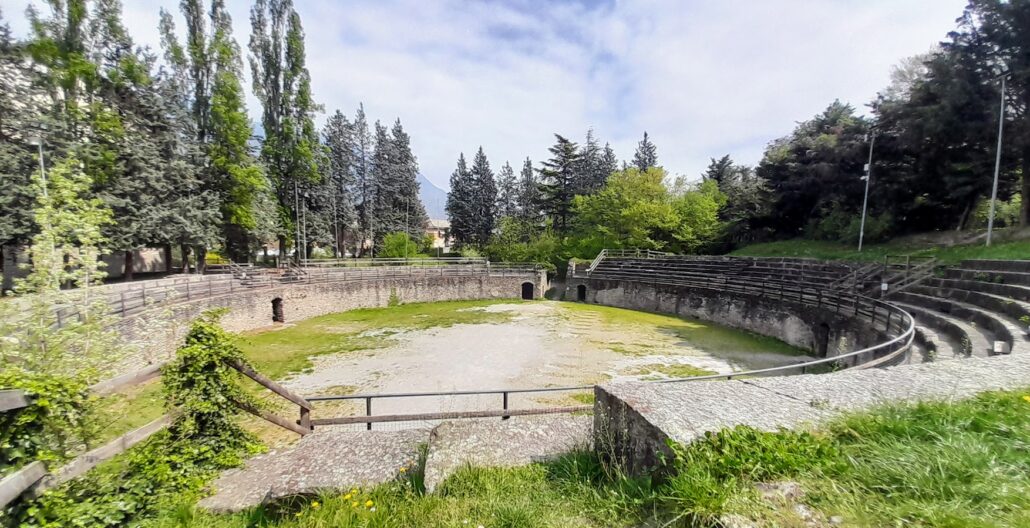
The Roman amphitheatre in Susa
Just outside the town center of Susa lies one of the most fascinating sites of Roman antiquity: the so-called Roman Arena, a small amphitheatre dating back to the 2nd–3rd century AD. Here, combats between gladiators and spectacular hunting scenes, known as venationes, took place, attracting audiences with exotic animals and thrilling fights.
The arena stands in a natural hollow, well sheltered from the wind, behind the ancient acropolis. With its elliptical shape measuring 45 by 37 meters, it is considered the smallest amphitheatre of Roman age in Italy. It was surrounded by a masonry podium supporting the seating tiers, probably limited to three rows, while officials watched the shows from specially built stands along the minor axis.
Beneath the structure lay a hidden but essential area: a corridor connected four chambers, the carceres, where gladiators and animals waited before entering the arena. There was also a space used as a stable for the beasts. Not far away, to the northeast, are the remains of a small circular building, possibly the spoliarium, where injured or dead gladiators were taken.
Probably abandoned as early as the 5th century, the arena was gradually buried by floods from the nearby stream. It was only between 1956 and 1961 that it was rediscovered, excavated, and partially reconstructed, as many of the stone blocks of the seating had been scattered over time.
But what did a typical day in the amphitheatre look like? The shows began with the venationes, followed around midday by executions, often involving condemned prisoners being thrown to wild beasts. In the afternoon, the gladiators entered the arena, with lighter, almost comic interludes in between to ease the tension of the audience.
Gladiators came from different backgrounds: initially linked to peoples conquered by Rome—such as Samnites, Gauls, and Thracians—they were recognizable by their specific weapons and armor. During the Imperial period, these categories became more standardized. The most famous type was the murmillo, equipped with a large shield, a decorated helmet, and a gladius. Alongside them fought Roman citizens of humble origin seeking fame and fortune.
They lived in the ludi, where they trained intensely and followed a diet based on cereals and legumes, designed to build a body mass capable of absorbing blows. Some became true celebrities, admired even by women.
Today, the Roman Arena of Susa preserves all the charm of a distant world, made of spectacle, violence, and great organization: a surprising precursor of modern stadiums.
Would you like to learn more? Then book a guided tour of the Susa Valley