
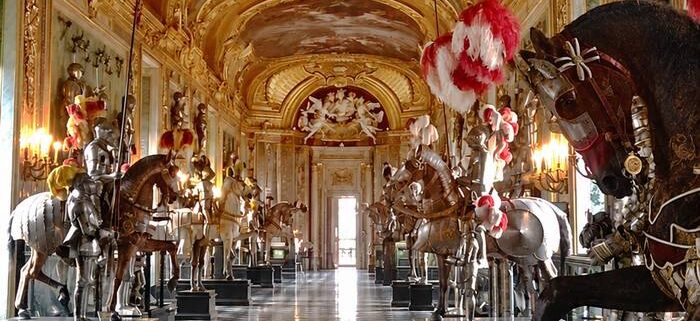
Armour, family treasures and extraordinary objects collected from across Europe are displayed in a museum that opened to the public in 1837 at the initiative of King Charles Albert: the Royal Armoury of Turin.
The visit begins in the small medal room, an intimate space that prepares visitors for the surprise of the gallery itself. As soon as you enter, you are struck by the perspective and the wealth of objects on display. The hall is an impressive 67 metres long, offering a spectacle that immediately captures the eye.
The nineteenth-century display is not simply a collection of weapons: it also evokes the world of theatre. The trophies arranged in the form of panoplies, decorative compositions of weapons, recall the stage sets of historical operas so popular in the nineteenth century. Together, these elements helped convey an idealised image of the sovereign: that of a just, valiant and courageous king, worthy of being celebrated as a knight.
However, the Gallery existed long before the Royal Armoury. It was built in 1732, during the reign of Charles Emmanuel III, as a reception hall. It was later decorated by the painter C. F. Beaumont with scenes from the story of Aeneas, while the architect B. Alfieri enhanced its appearance with polychrome marble and bas-reliefs celebrating the glories of Piedmont.
The true protagonists of the hall are the twelve mounted knights, arranged facing one another. The display begins with late medieval armour, accompanied by foot soldiers and mounted on tall wooden pedestals. This arrangement invites visitors to look upwards, almost as if they were contemplating statues or works of art.
And what about the horses? At first glance, they look like stuffed animals, but they are actually wooden sculptures covered with real horse hides. The sculptors skilfully reproduced a variety of poses: some horses rear up, like the one ridden by Prince Eugene at the far end of the gallery; others advance with a stately gait, like the horse of Duke Emmanuel Philibert. Together, these figures evoke scenes of battle, tournaments and military parades.
Among the most interesting suits of armour is the one first encountered on the right upon entering the hall, one of the most significant pieces acquired by Charles Albert. It belonged to a German knight from Nuremberg and probably dates from between 1520 and 1530. It is a composite suit of armour, fitted with interchangeable pieces that allowed it to be adapted both for warfare and for the joust, the mounted tournament. The embossed decorations depict centaurs with fish tails and a two-tailed mermaid, motifs associated with the owner’s coat of arms. The accessories also deserve attention. The wooden tournament lance dates from the nineteenth century, as do all the lances displayed in the gallery, but it is the horse’s armour that holds a particular surprise. Made from boiled and painted rhinoceros hide, it appears to have no connection with this suit of armour. The initials OHS, accompanied by a red heart, in fact refer to the marriage of another German prince: a small clue revealing how these objects can have complex and sometimes intertwined histories.
The Neo-Gothic display cases, designed by the architect Pelagio Palagi, take us even further back in time, to the Stone Age. Here we find flint axes, spearheads and daggers, evidence of a distant past.
We should not, however, be misled by the size of the display cases: the smallest ones, containing just a single object, may house truly exceptional pieces. One example is a sixteenth-century Venetian shield made from a sea turtle shell and covered with painted and gilded leather.
An unusual object that demonstrates how, in this gallery, weapons are not merely instruments of combat, but also works of art, symbols of prestige and small fragments of stories from across Europe.
Would you like to find out more? Book a guided tour of the Royal Palace of Turin.

The origins of the castle date back to the end of the 10th century, when a medieval fortress with defensive towers stood on the hill. However, its transformation into an elegant noble residence did not take place until the 17th century, when the Solaro family commissioned the project to the renowned architect Guarino Guarini, one of the leading figures of the Turin Baroque. Later, King Charles Felix transformed it into a magnificent summer residence. One of the most spectacular features of the visit is the monumental double-flight staircase, which leads directly to the piano nobile (the Noble Floor). From here, visitors can admire one of the most breathtaking panoramic views over the Roero and Langhe hills. Much of the marble and many of the statues decorating the staircase originally came from the monumental Fountain of Hercules at the Royal Palace of Venaria. When the fountain was dismantled in the 18th century, part of its sculptural decoration found a new home in Govone. The Atlantes, the allegorical figures of the Po and Dora rivers, and the bas-reliefs depicting the Labours of Hercules create a direct artistic link between two of the most important residences of the House of Savoy. The piano nobile still preserves the refined atmosphere of the 19th-century royal court. The King’s and Queen’s Apartments are richly decorated with magnificent frescoes inspired by Classical mythology. Among them stands out the Hall of Honour, where painted trompe-l’œil architecture transforms the walls into a spectacular gallery of statues. At the centre of the vaulted ceiling appears the myth of Niobe, inspired by the famous marble sculptural group preserved in the Uffizi Gallery and personally chosen by King Charles Felix during one of his visits to Florence. Among the castle’s most remarkable rooms are the Chinese Rooms, decorated with extraordinary hand-painted Chinese wallpapers produced in China during the 18th century. The scenes depict porcelain production, tea cultivation, silk manufacturing, and many aspects of everyday life. They are a precious example of the fashion for chinoiserie, which captivated European courts throughout the 18th century and still makes these rooms unique among the historic residences of Piedmont. The history of Govone Castle did not end with the fall of the monarchy. After being sold by the House of Savoy, the municipality purchased the building and used it as an elementary school, a kindergarten, municipal offices, and a magistrates’ court. Finally, its inscription on the UNESCO World Heritage List, together with the Royal Palace of Turin, made it possible to restore the piano nobile, which is now open to visitors.

The Galleria Subalpina, which connects Piazza Castello with Piazza Carlo Alberto, is one of the most elegant and representative spaces of nineteenth-century Turin. Designed in an eclectic style by engineer Pietro Carrera, it rises in an area of great historical significance: this was once the site of the ancient defensive bastions, built in 1610 to protect the city’s first expansion and later incorporated into the block designed by Carlo di Castellamonte to house the Ministry of Finance. A complex that lost its original function after the transfer of the capital, making way for the creation of this refined covered passage. The gallery was completed in less than two years and inaugurated in 1874. It measures approximately 50 metres in length and reaches 18 metres in height, immediately offering a monumental, bright and scenographic setting. Originally, the premises overlooking the gallery housed important, highly specialised commercial establishments, designed to cater to Turin’s upper bourgeoisie. Enhancing the pleasure of a stroll were the celebrated historic cafés, such as Baratti & Milano and the Caffè Concerto Romano, now converted into a cinema. It was precisely here, during the magical 1920s, that artists and soubrettes of great renown made their debut. The upper floor, once used as storage for the shops below and now occupied by offices and ancillary spaces, is accessible via two elegant marble staircases. This level is surrounded by a projecting balcony, characterised by a refined, finely worked cast-iron balustrade, punctuated by marble pilasters and completed by a wooden handrail. From the upper floor rises the majestic roof of iron and glass, pavilion-shaped, which floods the entire hall with natural light, giving it a sense of openness and freshness. In 1887, at the request of the Banca Subalpina, the original structure was modified with the insertion of a skylight, designed to improve ventilation and air circulation throughout the commercial space. Further enhancing the setting is the large central plant composition: three broad flowerbeds – one elliptical, larger at the centre, and two smaller and more rounded at the sides – surrounded by a band of rectangular concrete planters. The whole arrangement ideally recalls the design of a nineteenth-century parterre, creating a pleasant dialogue between architecture, light and nature.
Do you want to know more? Then book a guided tour of Turin in English

At the end of the 19th century, Turin changed its face. The city, already projected towards modernity after the transfer of the capital, was preparing for a profound urban renewal. Amid this ferment of construction sites and new visions, the old Via del Seminario – today’s Via XX Settembre – was extended up to Corso Regina Margherita, completely redesigning the layout of an entire district.
But this was not just any district. It was the so-called Swiss Quarter, so named because of the presence of the Swiss Guards who once lived there. A labyrinth of courtyards, adjoining buildings and narrow passages, which had developed over the centuries around the Palace of San Giovanni, the first Turin residence of Duke Emmanuel Philibert. Here, among the ancient houses of the cathedral’s canons, also stood the remains of the vanished palaeochristian basilica of San Salvatore: an area of inestimable archaeological value, buried beneath centuries of construction.
The renovation project was entrusted to engineer Emilio Stramucci, under an agreement between the Royal House and the Municipality of Turin. The goal? To share the costs of compensation for the demolitions and, at the same time, to ensure that this area – so symbolic for the city – would be redeveloped with the dignity it deserved, even after losing its status as capital.
Then, the unexpected happened: in 1899, during the excavation of the new foundations, the Roman Theatre of ancient Turin emerged from the depths of the earth. A monument until then completely unknown, which suddenly brought the city back to its past as Augusta Taurinorum.
A few years later, between the bell tower and the cathedral, another twist: the layout of the basilica of San Salvatore reappeared, with an extraordinary mosaic floor of black and white tesserae depicting Fortune turning her wheel – now preserved in the Diocesan Museum. The excavations also revealed remains of medieval cloisters, whose sculptures were transferred to the Civic Museum.
These entirely fortuitous discoveries allowed Alfredo d’Andrade, then director of the Office for the Conservation of Monuments, to reconstruct with greater precision the topography of Roman Turin – a true leap back in time beneath the feet of late 19th-century Turinese citizens.
In 1909, the building designed by Stramucci was finally completed. It was an elegant rectangular structure in 16th-century style, 116 metres long and 20 metres wide. Stramucci himself, already the author of the furnishings of the Royal Palace – where he had decorated the dining room, thus gaining the trust of Queen Margherita of Savoy – would also collaborate with her on the decoration of the romantic Castle of Gressoney-Saint-Jean.
The new Turin building, in turn, would go on to serve many different purposes over time: guesthouse and offices for royal officials, archives and storage facilities, and even a military hospital during the war. In fact, in 1898, the Royal Palace of Turin alone employed as many as 378 servants – a small city within the city, reflecting an era in which Turin lived suspended between the splendour of the court and the unstoppable energy of a modern age in full progress.
Do you want to know more? Then book a guided tour of Turin in English or discover with a guide the Royal Palace of Turin

Once known simply as Altessano, the town we now call Venaria Reale originally consisted of two small villages — the Lower and the Upper Borgo. The latter was considered healthier thanks to its higher elevation above the surrounding plain. The name Venaria was introduced by Duke Charles Emmanuel II of Savoy, who wished to transform the area into a royal hunting reserve, inspired by the French word vénerie, meaning “the art of horseback hunting.” From that moment, the two villages were united under one name: Venaria Reale. More than just a place of leisure for the royal court, Venaria soon became a hub of productive and commercial activity, thanks to its proximity to Turin and its abundant water sources. The goal was clear: to turn Venaria into a centre of manufacturing excellence, particularly in the lucrative silk trade — one of the most prized commodities of the time. To promote the town as a centre for silk production and trade, the architect Amedeo di Castellamonte designed Piazza dell’Annunziata with remarkable urban vision. The many shops and workshops facing the arcades were clearly visible from the street, allowing artisans to work silk and fine fabrics in view of passersby, showcasing their skills and techniques. The concept was that of an open-air laboratory, where craftsmanship and commerce could merge into one elegant urban space. The manufacturing complex was built on the right bank of the nearby Ceronda stream, carefully located to accommodate every stage of the production cycle. The plant was equipped with hydraulic wheels powered by the waters of a canal diverted from the Dora Riparia, providing the energy needed to operate the machinery. Silk production — initially carried out by women working from home — gradually evolved into an organised and profitable industry. To support this new industrial centre, the House of Savoy introduced tax exemptions, financial incentives and protectionist measures, encouraging the establishment of the first silk manufactories around 1670. By the mid-19th century, silk spinning employed more than 600 workers, and in the 20th century the factory was taken over by the company Snia Viscosa, which eventually employed over 6,000 people. It was mainly Venetian immigrants, recruited directly by Snia, who gave the town its new identity. The company provided them with housing in a vast workers’ district, around which the church of San Francesco was later built. Many chose to settle permanently in Venaria: in nearby Turin, housing was scarce or unaffordable, and newcomers from southern Italy often faced discrimination. Thus, through factories, workshops, new communities and the lingering splendour of the Savoy court, Venaria evolved from a rural village into a lively royal — and later industrial — town, where work, creativity and beauty have continued to intertwine up to the present day.
Do you want to know more? Then book a guided tour of the Royal Palace of Venaria in English

It was a cold winter evening in 1896 when, in an improvised screening room in Turin, the first flickering images appeared on a white sheet. The people of Turin were speechless: before their eyes, a mischievous child soaked a gardener with water, and a train seemed to come rushing out of the screen. The films were French, of course: *L’Arroseur arrosé* and *L’Arrivée d’un train en gare*. In those early years, cinema spoke French… even the word *film* was feminine! It was short for *pellicola cinematografica* (cinematographic film), and remained feminine in Italian until the 1930s.
Then, something changed. A visionary optician from Turin, Arturo Ambrosio, began making films. His first production — the Susa–Moncenisio car race — was a resounding success. And so, the Italian film industry was born.
In Turin, Ambrosio built the first glass houses — huge studios with glass walls and roofs designed to capture as much natural light as possible. The phenomenon exploded: companies like Itala Films sprang up, along with many others, some of which lasted no longer than a film reel. Turin became an open-air set: filming took place in Art Nouveau villas, along tree-lined hill roads, and even inside the Medieval Village. It was during this period that the local expression “Non fare il cine!” emerged — a playful way of saying “Don’t be so dramatic!” or “Stop acting!” At the time, Turin’s directors and technicians were in high demand, and their films were bought “sight unseen.” By 1912, the city already boasted 20 cinemas, half of them along Via Roma. But sound cinema had not yet arrived, and once screenings ended, films were often destroyed to salvage the silver salts. Luckily, one legend was preserved: Cabiria — a groundbreaking epic filmed across Turin, Sicily, and Tunisia. The title? It was the idea of Gabriele D’Annunzio, who was hiding out in Paris from his creditors. He wrote the intertitles, chose the names, and gave the film its epic tone. It also marked the birth of the myth of Maciste, portrayed by the enormous Bartolomeo Pagano, a dockworker from the port of Genoa turned movie star. But the true mastermind behind Cabiria was Giovanni Pastrone, who signed the film as “Piero Fosco” — because back then, cinema was still considered by many as a frivolous pastime.
And yet, right here in Turin, the seventh art was learning to walk, driven by dreams and creative genius.
Enjoy a truly unique experience in the heart of Turin: uncover the secrets of the National Cinema Museum inside the spectacular Mole Antonelliana! Book your guided tour now and let yourself be enchanted by the magic of cinema.

The chasse à courre or hunting on horseback with dogs is an ancient practice that spread in France as well as in the States of Savoy, starting from the Renaissance. All sovereigns hunted despite their age or ailments, such as gout, even two or three times a week. Hunting was inseparable from the king’s role, as the historian Philippe Salvadori reminds us in the «Portrait du roi en chasseur».
Its organization was a responsibility of the Master of Stables, a specific section of the Savoy court. The latter, according to the Habsburg model, was structured into three sectors: in addition to the Stables, it also included the Chamber and the court itself, which respectively represented the private public and aspects of the prince.
It was in the 18th century that hunting, often identified with the value and prestige of the sovereign, reached its apogee. The deer is the animal par excellence, the king of the forests. Hunting requires various knowledge and several expert crews. The deer, surprised by the dogs, runs away in a desperate attempt to get rid of its pursuers. Overcome by exhaustion, the animal stops, now besieged by the herd. It is the so-called hallali in which the grand hunter or the guest of honor inflicts the decisive blow with a spear. The actions are accompanied by fanfares of horns and trumpets that mark the different phases of the hunt. The last act of this show follows, the curée, hot or cold, with the distribution of the less noble parts of the prey to the dogs as a reward for the task performed.
Royal hunts have left a deep mark on the Piedmont region, from the creation of routes and paths, today perfectly recognizable, to the refined residences that are UNESCO heritage sites, in the Turin area. The Royal Palace of Venaria Reale and the Palazzina of Stupinigi were the ideal setting during the 17th and 18th centuries to celebrate the art of hunting and describe the spirit of the time.
Do you want to know more? Then book a guided tour of the Royal Palace of Venaria in English

During the 19th century, the Royal Palace of Turin also underwent major transformations inspired by the neoclassical and romantic atmospheres of the time. In 1834, King Carlo Alberto of Savoy-Carignano commissioned the Bolognese architect Pelagio Pelagi to update the royal apartments to the new classical taste.
Under his direction, in a refined and eclectic construction site, painters, sculptors, bronze workers, upholsterers and minusieri achieved a perfect synthesis between the Baroque tradition and new trends.
In the Hall of the Swiss Guards, for example, the 17th-century tapestry was replaced with a glossy green stucco covering imitating the underlying marble. The same sculptor Giuseppe Gaggini created two wall tables to protect the large painting of the Battle of San Quintino, by Palma il Giovane, from the heating coming from the heat vents below and redesigned the frame. In 1842, on the occasion of the wedding of Vittorio Emanuele II to Maria Adelaide of Habsburg-Lorraine, 44 bronze appliques were installed for the gas lighting of the palace. On the same day, 12 April 1842, the sumptuous ballroom was also inaugurated. The eight neo-Empire style chandeliers stand out, characterised by a double-crown bronze structure, culminating with palmettes and joined by long chains of cut Bohemian crystal of various shapes and diamond cut, made by the bronze workers Colla and Odetti of Turin.
After seven years of intense work, the ideal scenario for court dances was born. In the nineteenth century, social dances allowed people to create relationships and exchange information. Dance was a precious opportunity to approach other people and in particular the waltz, in which the gentleman, by putting an arm around the lady’s waist, could come into contact more easily. If with the quadrille there was only a touch, now the gentleman could finally hug the lady. This is why the waltz, nicknamed the dance of love, was initially considered scandalous and too daring.
Do you want to know more? Then book a guided tour of Turin in English or discover with a guide the Royal Palace of Turin

Amenhotep II, son of Pharaoh Thutmose III, lived in the 15th century BC. The ruler belonging to the XVIII dynasty is remembered for his physical prowess and sporting ability of which he was proud. In fact, sources describe him as an expert archer, a skilled boat helmsman and a fearless chariot driver.
In addition to following in the footsteps of his father who had been the greatest conqueror of Egypt, Amenhotep was able to establish a climate of peace and wealth. In the first part of his reign he carried out a military program modeled after his father, while in the second he devoted himself to stabilizing the country, with a careful administration, as reflected in the exceptional artistic production of the period.
Amenhotep II is the only ruler, besides Tutankhamun, whose mummy was found inside his own tomb, in the Valley of the Kings. Discovered by the French archaeologist Victor Loret, at the end of the 19th century, it is now preserved in the Cairo Museum, together with some finds found inside the tomb. In fact, the archaeologist found around fifteen mummies there. The same tomb had been reused as a hiding place for the remains of other pharaohs and royal figures, to protect them from destruction, around 1000 BC. This was a practice known in Egypt: in difficult times, when tombs were robbed, officials would secure the mummies of the rulers, to ensure that they would continue to live for eternity.
The sculpture in pink granite of the Egyptian Museum in Turin presents the pharaoh Amenhotep II serene, with a hint of a smile, natural eyes, a muscular and strong body. In the new installation of the Gallery of Kings , Amenhotep is placed in front of his father Thutmose III, with whom he reigned in co-regency in the early years. The king is kneeling, offering two vessels of wine to the deities, in his role as intermediary between the human and divine worlds. Wine was considered an expensive drink, reserved for the wealthy classes, and at the same time an offering in religious and funerary rites.
Do you want to know more? Then book a guided tour of Turin in English or discover with a guide the Egyptian Museum in Turin