Turin’s hidden city
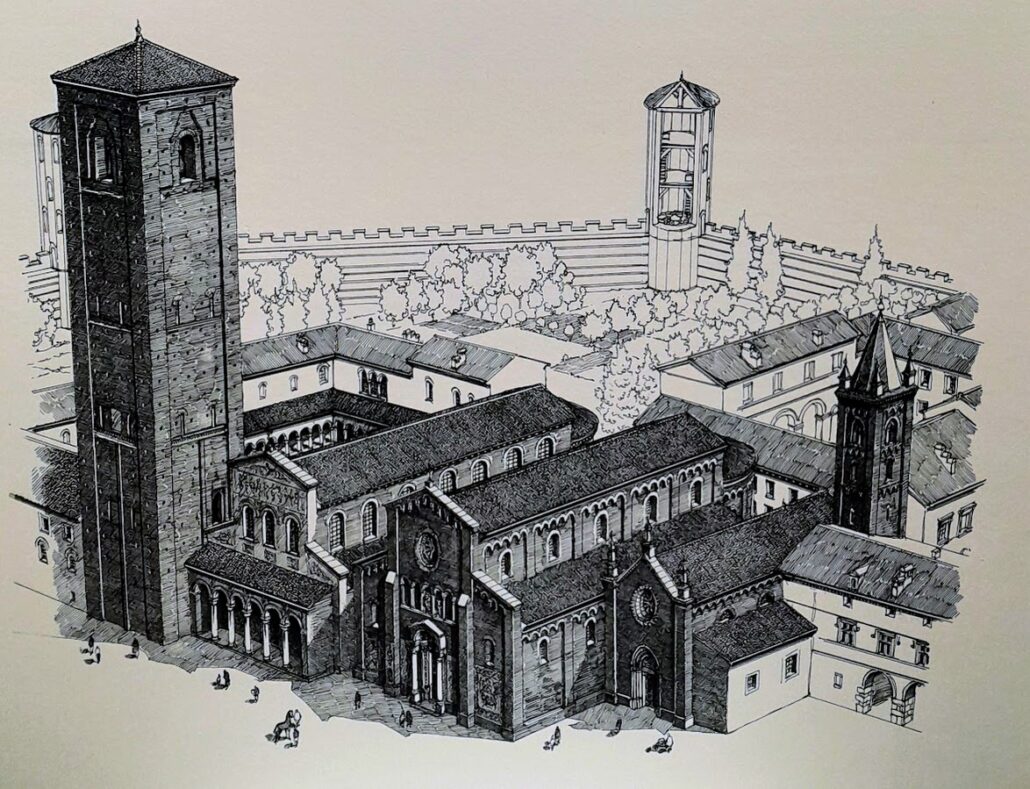
Beneath the present-day Cathedral of Turin, a surprising world unfolds. Archaeological studies have revealed that here, before the Renaissance building we admire today, three interconnected early Christian churches once stood. Near the city walls rose the main basilica dedicated to the Holy Saviour; beside it, the baptistery dedicated to Saint John the Baptist — later incorporated into a third church — and finally a basilica devoted to Saint Mary. Three sacred buildings communicating with one another, forming an imposing complex for a city that was still far from becoming a capital. Imagine the medieval urban landscape: behind the churches, stretching as far as the Roman walls — exactly where the Royal Palace stands today — lay the episcopal palace, the canons’ residence of Santo Salvatore with its cloister, quiet courtyards, gardens, and even the cemetery. This was the spiritual heart of ancient Turin.
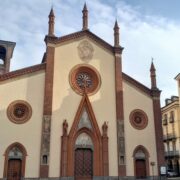
Then, in 1482, came a turning point. Cardinal Domenico della Rovere, a member of a powerful family and related to Pope Sixtus IV, decided to offer the city a new cathedral. His name is still carved on the portals, like a signature in stone. For the construction, he commissioned the Florentine architect Amedeo di Francesco Settignano, bringing to Turin a breath of artistic renewal.
The ancient churches were demolished, making way for a cathedral inspired by Santa Maria Novella in Florence. The two large lateral volutes of the façade, which conceal the slope of the roof, echo the innovation introduced by Leon Battista Alberti — a detail that marks the arrival of the Renaissance in Piedmont, a region still deeply rooted in the Gothic style influenced by France.
Today, the Cathedral may appear modest compared to other famous Italian cathedrals. Yet when it was inaugurated, Turin had fewer than five thousand inhabitants, and its diocese still depended on Milan.
Visiting the Diocesan Museum of Turin therefore means embarking on a vertical journey: from the Renaissance down to early Christian origins, from Renaissance splendour to Roman and medieval Turin. It is an experience that enriches any walk through the historic centre, reminding us that a city is not only what we see on the surface, but also what continues to live, silently, beneath our feet.
Would you like to learn more? Then book a guided tour of Turin in English