Turin and more
  • About me
  • Turin guided tours
  • Tailor Made Tours
    • Andalusia
    • Sicily
    • Normandy and Brittany
  • Conditions
  • Blog
  • Contact
  • English
    • French
    • Spanish
  • Menu Menu
  • Link to Facebook
  • Link to Instagram

Tag Archive for: #turinroyalpalace; #turin; #privateguidedtour; #unescoworldheritage; #piedmont; #museireali

The Royal Armoury of Turin

in Must-see

Armour, family treasures and extraordinary objects collected from across Europe are displayed in a museum that opened to the public in 1837 at the initiative of King Charles Albert: the Royal Armoury of Turin.
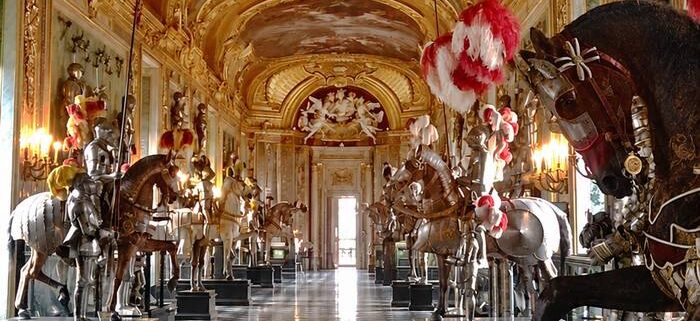
The visit begins in the small medal room, an intimate space that prepares visitors for the surprise of the gallery itself. As soon as you enter, you are struck by the perspective and the wealth of objects on display. The hall is an impressive 67 metres long, offering a spectacle that immediately captures the eye.
The nineteenth-century display is not simply a collection of weapons: it also evokes the world of theatre. The trophies arranged in the form of panoplies, decorative compositions of weapons, recall the stage sets of historical operas so popular in the nineteenth century. Together, these elements helped convey an idealised image of the sovereign: that of a just, valiant and courageous king, worthy of being celebrated as a knight.
However, the Gallery existed long before the Royal Armoury. It was built in 1732, during the reign of Charles Emmanuel III, as a reception hall. It was later decorated by the painter C. F. Beaumont with scenes from the story of Aeneas, while the architect B. Alfieri enhanced its appearance with polychrome marble and bas-reliefs celebrating the glories of Piedmont.
The true protagonists of the hall are the twelve mounted knights, arranged facing one another. The display begins with late medieval armour, accompanied by foot soldiers and mounted on tall wooden pedestals. This arrangement invites visitors to look upwards, almost as if they were contemplating statues or works of art.
And what about the horses? At first glance, they look like stuffed animals, but they are actually wooden sculptures covered with real horse hides. The sculptors skilfully reproduced a variety of poses: some horses rear up, like the one ridden by Prince Eugene at the far end of the gallery; others advance with a stately gait, like the horse of Duke Emmanuel Philibert. Together, these figures evoke scenes of battle, tournaments and military parades.
Among the most interesting suits of armour is the one first encountered on the right upon entering the hall, one of the most significant pieces acquired by Charles Albert. It belonged to a German knight from Nuremberg and probably dates from between 1520 and 1530. It is a composite suit of armour, fitted with interchangeable pieces that allowed it to be adapted both for warfare and for the joust, the mounted tournament. The embossed decorations depict centaurs with fish tails and a two-tailed mermaid, motifs associated with the owner’s coat of arms. The accessories also deserve attention. The wooden tournament lance dates from the nineteenth century, as do all the lances displayed in the gallery, but it is the horse’s armour that holds a particular surprise. Made from boiled and painted rhinoceros hide, it appears to have no connection with this suit of armour. The initials OHS, accompanied by a red heart, in fact refer to the marriage of another German prince: a small clue revealing how these objects can have complex and sometimes intertwined histories.
The Neo-Gothic display cases, designed by the architect Pelagio Palagi, take us even further back in time, to the Stone Age. Here we find flint axes, spearheads and daggers, evidence of a distant past.
We should not, however, be misled by the size of the display cases: the smallest ones, containing just a single object, may house truly exceptional pieces. One example is a sixteenth-century Venetian shield made from a sea turtle shell and covered with painted and gilded leather.
An unusual object that demonstrates how, in this gallery, weapons are not merely instruments of combat, but also works of art, symbols of prestige and small fragments of stories from across Europe.

Would you like to find out more? Book a guided tour of the Royal Palace of Turin.

https://www.turinandmore.com/wp-content/uploads/2026/10/Galleria_barocca_200kb.jpg 1268 700 Andrea https://www.turinandmore.com/wp-content/uploads/2019/07/logodef-1-300x208.png Andrea2026-10-23 19:59:292026-10-23 20:29:11The Royal Armoury of Turin

Royal Castle of Govone: The Savoy Residence in the Heart of the Roero

in Must-see

The origins of the castle date back to the end of the 10th century, when a medieval fortress with defensive towers stood on the hill. However, its transformation into an elegant noble residence did not take place until the 17th century, when the Solaro family commissioned the project to the renowned architect Guarino Guarini, one of the leading figures of the Turin Baroque. Later, King Charles Felix transformed it into a magnificent summer residence. One of the most spectacular features of the visit is the monumental double-flight staircase, which leads directly to the piano nobile (the Noble Floor). From here, visitors can admire one of the most breathtaking panoramic views over the Roero and Langhe hills. Much of the marble and many of the statues decorating the staircase originally came from the monumental Fountain of Hercules at the Royal Palace of Venaria. When the fountain was dismantled in the 18th century, part of its sculptural decoration found a new home in Govone. The Atlantes, the allegorical figures of the Po and Dora rivers, and the bas-reliefs depicting the Labours of Hercules create a direct artistic link between two of the most important residences of the House of Savoy. The piano nobile still preserves the refined atmosphere of the 19th-century royal court. The King’s and Queen’s Apartments are richly decorated with magnificent frescoes inspired by Classical mythology. Among them stands out the Hall of Honour, where painted trompe-l’œil architecture transforms the walls into a spectacular gallery of statues. At the centre of the vaulted ceiling appears the myth of Niobe, inspired by the famous marble sculptural group preserved in the Uffizi Gallery and personally chosen by King Charles Felix during one of his visits to Florence. Among the castle’s most remarkable rooms are the Chinese Rooms, decorated with extraordinary hand-painted Chinese wallpapers produced in China during the 18th century. The scenes depict porcelain production, tea cultivation, silk manufacturing, and many aspects of everyday life. They are a precious example of the fashion for chinoiserie, which captivated European courts throughout the 18th century and still makes these rooms unique among the historic residences of Piedmont. The history of Govone Castle did not end with the fall of the monarchy. After being sold by the House of Savoy, the municipality purchased the building and used it as an elementary school, a kindergarten, municipal offices, and a magistrates’ court. Finally, its inscription on the UNESCO World Heritage List, together with the Royal Palace of Turin, made it possible to restore the piano nobile, which is now open to visitors.

https://www.turinandmore.com/wp-content/uploads/2026/07/20260703_1555592.jpg 2000 1273 Andrea https://www.turinandmore.com/wp-content/uploads/2019/07/logodef-1-300x208.png Andrea2026-07-06 20:45:172026-07-06 20:46:06Royal Castle of Govone: The Savoy Residence in the Heart of the Roero

Turin’s hidden city

in Trip Inspiration

Beneath the present-day Cathedral of Turin, a surprising world unfolds. Archaeological studies have revealed that here, before the Renaissance building we admire today, three interconnected early Christian churches once stood. Near the city walls rose the main basilica dedicated to the Holy Saviour; beside it, the baptistery dedicated to Saint John the Baptist — later incorporated into a third church — and finally a basilica devoted to Saint Mary. Three sacred buildings communicating with one another, forming an imposing complex for a city that was still far from becoming a capital. Imagine the medieval urban landscape: behind the churches, stretching as far as the Roman walls — exactly where the Royal Palace stands today — lay the episcopal palace, the canons’ residence of Santo Salvatore with its cloister, quiet courtyards, gardens, and even the cemetery. This was the spiritual heart of ancient Turin.
Then, in 1482, came a turning point. Cardinal Domenico della Rovere, a member of a powerful family and related to Pope Sixtus IV, decided to offer the city a new cathedral. His name is still carved on the portals, like a signature in stone. For the construction, he commissioned the Florentine architect Amedeo di Francesco Settignano, bringing to Turin a breath of artistic renewal.
The ancient churches were demolished, making way for a cathedral inspired by Santa Maria Novella in Florence. The two large lateral volutes of the façade, which conceal the slope of the roof, echo the innovation introduced by Leon Battista Alberti — a detail that marks the arrival of the Renaissance in Piedmont, a region still deeply rooted in the Gothic style influenced by France.
Today, the Cathedral may appear modest compared to other famous Italian cathedrals. Yet when it was inaugurated, Turin had fewer than five thousand inhabitants, and its diocese still depended on Milan.
Visiting the Diocesan Museum of Turin therefore means embarking on a vertical journey: from the Renaissance down to early Christian origins, from Renaissance splendour to Roman and medieval Turin. It is an experience that enriches any walk through the historic centre, reminding us that a city is not only what we see on the surface, but also what continues to live, silently, beneath our feet.

Would you like to learn more? Then book a guided tour of Turin in English

https://www.turinandmore.com/wp-content/uploads/2026/02/Museo-diocesano-di-Torino.jpg 899 1174 Andrea https://www.turinandmore.com/wp-content/uploads/2019/07/logodef-1-300x208.png Andrea2026-02-14 11:21:372026-02-14 11:27:24Turin’s hidden city

Turin: a capital before its time

in Trip Inspiration

Many people believe that Turin became the capital of Piedmont with the return of Emmanuel Philibert of Savoy after the French occupation, but this is more a legend than a historical fact. As historian Alessandro Barbero points out, the city had already taken on this role much earlier, thanks to deliberate and well-defined choices.
At the end of the Middle Ages, Turin had around 5,000 inhabitants, a figure similar to that of Pinerolo and smaller than cities such as Moncalieri, Vercelli, or Mondovì. It was therefore not demographic size that made it important, but its strategic location and the measures adopted by the Savoy rulers.
Between the fourteenth and fifteenth centuries, the Princes of Achaea (the cadet branch of the House of Savoy that ruled Piedmont) resided in Pinerolo, about 40 km (25 miles) from Turin, when they decided to found a university. The aim was to train jurists and officials capable of administering an increasingly complex state. Until then, Piedmontese students had to travel to Pavia, in the Duchy of Milan—a rival state—to complete their studies.
After the crisis of the Duchy of Milan in 1402, following the death of Gian Galeazzo Visconti, professors and students sought a new location. Turin proved to be the most suitable thanks to its position and connections. Thus the University of Turin was founded, the first concrete step toward its role as a capital. Even when the university was temporarily transferred to Chieri, the Turin city council worked to bring it back, recognizing its strategic and cultural importance.
This was followed by the permanent establishment of the Cismontane Council, the governing body and high court of Piedmont, initially based in Pinerolo and later moved to Turin. With both the university and the central government located there, the city effectively became the capital of the Savoy state.
When the French invaded Piedmont in 1536, Turin was already the capital. Therefore, when Emmanuel Philibert returned in 1561, there was no relocation: the duke simply settled in a city that had long been the political and cultural heart of Piedmont.

Would you like to learn more? Then book a guided tour of Turin in English

https://www.turinandmore.com/wp-content/uploads/2026/01/San-Donato.jpg 899 1598 Andrea https://www.turinandmore.com/wp-content/uploads/2019/07/logodef-1-300x208.png Andrea2026-01-28 17:49:382026-01-28 18:03:22Turin: a capital before its time

A refined passage through Turin’s history

in Must-see

The Galleria Subalpina, which connects Piazza Castello with Piazza Carlo Alberto, is one of the most elegant and representative spaces of nineteenth-century Turin. Designed in an eclectic style by engineer Pietro Carrera, it rises in an area of great historical significance: this was once the site of the ancient defensive bastions, built in 1610 to protect the city’s first expansion and later incorporated into the block designed by Carlo di Castellamonte to house the Ministry of Finance. A complex that lost its original function after the transfer of the capital, making way for the creation of this refined covered passage. The gallery was completed in less than two years and inaugurated in 1874. It measures approximately 50 metres in length and reaches 18 metres in height, immediately offering a monumental, bright and scenographic setting. Originally, the premises overlooking the gallery housed important, highly specialised commercial establishments, designed to cater to Turin’s upper bourgeoisie. Enhancing the pleasure of a stroll were the celebrated historic cafés, such as Baratti & Milano and the Caffè Concerto Romano, now converted into a cinema. It was precisely here, during the magical 1920s, that artists and soubrettes of great renown made their debut. The upper floor, once used as storage for the shops below and now occupied by offices and ancillary spaces, is accessible via two elegant marble staircases. This level is surrounded by a projecting balcony, characterised by a refined, finely worked cast-iron balustrade, punctuated by marble pilasters and completed by a wooden handrail. From the upper floor rises the majestic roof of iron and glass, pavilion-shaped, which floods the entire hall with natural light, giving it a sense of openness and freshness. In 1887, at the request of the Banca Subalpina, the original structure was modified with the insertion of a skylight, designed to improve ventilation and air circulation throughout the commercial space. Further enhancing the setting is the large central plant composition: three broad flowerbeds – one elliptical, larger at the centre, and two smaller and more rounded at the sides – surrounded by a band of rectangular concrete planters. The whole arrangement ideally recalls the design of a nineteenth-century parterre, creating a pleasant dialogue between architecture, light and nature.

Do you want to know more? Then book a guided tour of Turin in English

https://www.turinandmore.com/wp-content/uploads/2021/04/Visita-guidata-Torino-galleria-4.jpg 606 495 Andrea https://www.turinandmore.com/wp-content/uploads/2019/07/logodef-1-300x208.png Andrea2025-12-15 09:13:072025-12-15 09:13:07A refined passage through Turin’s history

The New Wing of the Royal Palace of Turin

in Must-see

At the end of the 19th century, Turin changed its face. The city, already projected towards modernity after the transfer of the capital, was preparing for a profound urban renewal. Amid this ferment of construction sites and new visions, the old Via del Seminario – today’s Via XX Settembre – was extended up to Corso Regina Margherita, completely redesigning the layout of an entire district.
But this was not just any district. It was the so-called Swiss Quarter, so named because of the presence of the Swiss Guards who once lived there. A labyrinth of courtyards, adjoining buildings and narrow passages, which had developed over the centuries around the Palace of San Giovanni, the first Turin residence of Duke Emmanuel Philibert. Here, among the ancient houses of the cathedral’s canons, also stood the remains of the vanished palaeochristian basilica of San Salvatore: an area of inestimable archaeological value, buried beneath centuries of construction.
The renovation project was entrusted to engineer Emilio Stramucci, under an agreement between the Royal House and the Municipality of Turin. The goal? To share the costs of compensation for the demolitions and, at the same time, to ensure that this area – so symbolic for the city – would be redeveloped with the dignity it deserved, even after losing its status as capital.
Then, the unexpected happened: in 1899, during the excavation of the new foundations, the Roman Theatre of ancient Turin emerged from the depths of the earth. A monument until then completely unknown, which suddenly brought the city back to its past as Augusta Taurinorum.
A few years later, between the bell tower and the cathedral, another twist: the layout of the basilica of San Salvatore reappeared, with an extraordinary mosaic floor of black and white tesserae depicting Fortune turning her wheel – now preserved in the Diocesan Museum. The excavations also revealed remains of medieval cloisters, whose sculptures were transferred to the Civic Museum.
These entirely fortuitous discoveries allowed Alfredo d’Andrade, then director of the Office for the Conservation of Monuments, to reconstruct with greater precision the topography of Roman Turin – a true leap back in time beneath the feet of late 19th-century Turinese citizens.
In 1909, the building designed by Stramucci was finally completed. It was an elegant rectangular structure in 16th-century style, 116 metres long and 20 metres wide. Stramucci himself, already the author of the furnishings of the Royal Palace – where he had decorated the dining room, thus gaining the trust of Queen Margherita of Savoy – would also collaborate with her on the decoration of the romantic Castle of Gressoney-Saint-Jean.
The new Turin building, in turn, would go on to serve many different purposes over time: guesthouse and offices for royal officials, archives and storage facilities, and even a military hospital during the war. In fact, in 1898, the Royal Palace of Turin alone employed as many as 378 servants – a small city within the city, reflecting an era in which Turin lived suspended between the splendour of the court and the unstoppable energy of a modern age in full progress.

Do you want to know more? Then book a guided tour of Turin in English or discover with a guide the Royal Palace of Turin

https://www.turinandmore.com/wp-content/uploads/2025/11/Galleria-archeologica-Musei-Reali.jpeg 788 435 Andrea https://www.turinandmore.com/wp-content/uploads/2019/07/logodef-1-300x208.png Andrea2025-11-13 20:33:452025-11-13 20:33:45The New Wing of the Royal Palace of Turin

The neoclassical and romantic taste of Turin Royal Palace

in Must-see

During the 19th century, the Royal Palace of Turin also underwent major transformations inspired by the neoclassical and romantic atmospheres of the time. In 1834, King Carlo Alberto of Savoy-Carignano commissioned the Bolognese architect Pelagio Pelagi to update the royal apartments to the new classical taste.
Under his direction, in a refined and eclectic construction site, painters, sculptors, bronze workers, upholsterers and minusieri achieved a perfect synthesis between the Baroque tradition and new trends.
In the Hall of the Swiss Guards, for example, the 17th-century tapestry was replaced with a glossy green stucco covering imitating the underlying marble. The same sculptor Giuseppe Gaggini created two wall tables to protect the large painting of the Battle of San Quintino, by Palma il Giovane, from the heating coming from the heat vents below and redesigned the frame. In 1842, on the occasion of the wedding of Vittorio Emanuele II to Maria Adelaide of Habsburg-Lorraine, 44 bronze appliques were installed for the gas lighting of the palace. On the same day, 12 April 1842, the sumptuous ballroom was also inaugurated. The eight neo-Empire style chandeliers stand out, characterised by a double-crown bronze structure, culminating with palmettes and joined by long chains of cut Bohemian crystal of various shapes and diamond cut, made by the bronze workers Colla and Odetti of Turin.
After seven years of intense work, the ideal scenario for court dances was born. In the nineteenth century, social dances allowed people to create relationships and exchange information. Dance was a precious opportunity to approach other people and in particular the waltz, in which the gentleman, by putting an arm around the lady’s waist, could come into contact more easily. If with the quadrille there was only a touch, now the gentleman could finally hug the lady. This is why the waltz, nicknamed the dance of love, was initially considered scandalous and too daring.

Do you want to know more? Then book a guided tour of Turin in English or discover with a guide the Royal Palace of Turin

https://www.turinandmore.com/wp-content/uploads/2025/06/Palazzo-Reale-di-Torino.jpg 788 626 Andrea https://www.turinandmore.com/wp-content/uploads/2019/07/logodef-1-300x208.png Andrea2025-06-30 11:22:552025-06-30 11:24:48The neoclassical and romantic taste of Turin Royal Palace

Restoration of the Scurolo in Turin Cathedral

in Must-see

Until the early nineteenth century, the large Guarini portal served as the backdrop to the choir of the Cathedral. For those who were in the cathedral they could see in perspective the altar with the reliquary surmounted by the golden rays and the chapel naturally illuminated from the conical-pyramid shaped dome. In 1825 this sequence of spaces was strongly modified by the construction of a glass window commissioned by King Carlo Felice to protect the chapel from the cold and noise coming from the church below.
It was created in neoclassical style, elegant and essential, by the royal architect Carlo Randoni as if it were a large glass panel, with wooden and gilded iron frames. Then Guarini’s project based on the spatial continuity of the two environments was partly disregarded.
Luckily recent renovations have restored the area below to its original splendour. The so-called scurolo, the dimly lit room which supports the chapel of the Shroud, represents the connection between the baroque chapel and the pre-existing Renaissance structure. Behind the main altar, you can see again a choir of musician angels painted by Domenico Guidobono in 1709. The arch marked by marble columns was the entrance to the scurolo, used in addition to the sacristy for dressing during large ceremonies or storing sacred furnishings.

Do you want to know more?Then book a guided tour of Turin

https://www.turinandmore.com/wp-content/uploads/2024/11/IMG_20230208_170237_106.jpg 799 598 Andrea https://www.turinandmore.com/wp-content/uploads/2019/07/logodef-1-300x208.png Andrea2024-11-18 08:18:162024-11-18 08:28:36Restoration of the Scurolo in Turin Cathedral

Turin Royal Zoological Garden

in Must-see

Turin, having become the capital of Italy, regained the old splendor. As the rulers of the main European capitals had done, king Victor Emmanuel II, notoriously passionate about animals, also decided to create a zoo.

The idea probably came from the arrival of some pygmy goats and antelopes gifted from Egypt. Pagodas and buildings in Moorish style were thus built in the lower gardens of the Royal Palace to recall the exotic character of the animals housed and communicate to the visitor an idea of the rare and distant.

The economic effort was notable despite the difficult economic moment of the State and the subsequent transfer of the court. Around 1874, the zoo can be said to be completed. There were among others elephants, giraffes, lions, bears and wolves. The animals were purchased directly in their countries of origin or they could be gifts from rulers or important people. For example, in a letter, king Victor Emmanuel II thanked his daughter Maria Clotilde, wife of Jérôme Bonaparte, for having given him some kangaroos.
Entrance, which was free, after leaving your personal details in a special register, took place from Corso San Maurizio.

Do you want to know more? Then book a private tour of Turin Royal Palace

https://www.turinandmore.com/wp-content/uploads/2024/10/Royal-Gardens.jpg 799 1068 Andrea https://www.turinandmore.com/wp-content/uploads/2019/07/logodef-1-300x208.png Andrea2024-10-14 20:10:402024-10-14 20:12:57Turin Royal Zoological Garden

Categories

  • contemporary art
  • gastronomy
  • Must-see
  • Trip Inspiration

Archives

  • November 2026
  • October 2026
  • September 2026
  • August 2026
  • July 2026
  • April 2026
  • March 2026
  • February 2026
  • January 2026
  • December 2025
  • November 2025
  • October 2025
  • September 2025
  • August 2025
  • July 2025
  • June 2025
  • May 2025
  • April 2025
  • March 2025
  • February 2025
  • January 2025
  • December 2024
  • November 2024
  • October 2024

Menu

  • Home
  • About me
  • Contact

Turin and Piedmont guided tours

by Andrea Clementino

Events and Tailor Made Tours

Privacy


  • Turin and Piedmont Guided tours
  • Tailor Made Tours
P.IVA 11200290010 © Copyright - Turin&More | WD: Officina Informatica
  • Link to Facebook
  • Link to Instagram
Scroll to top Scroll to top Scroll to top

WhatsApp