
Royal Castle of Govone: the Savoy Residence in the Heart of the Roero
The origins of the castle date back to the late 10th century, when the hill was occupied by a medieval fortress with defensive towers. Its transformation into an elegant noble residence, however, took place in the 17th century thanks to the Solaro family, who commissioned the renowned architect Guarino Guarini, a leading figure of Turin Baroque architecture. Later, King Carlo Felice transformed it into a refined summer residence.
One of the most spectacular features of the visit is the monumental double-flight staircase, which leads directly to the piano nobile. From here, the view opens onto one of the most evocative panoramas of the entire Roero and Langhe region. Many of the marble elements and statues decorating the staircase originally came from the monumental Fountain of Hercules at the Royal Palace of Venaria. When the fountain was dismantled in the 18th century, some of its decorative elements found a new home at Govone. The telamons, the allegorical figures of the Po and Dora rivers, and the bas-reliefs depicting the Labours of Hercules thus create a direct artistic link between two of the most important Savoy residences.
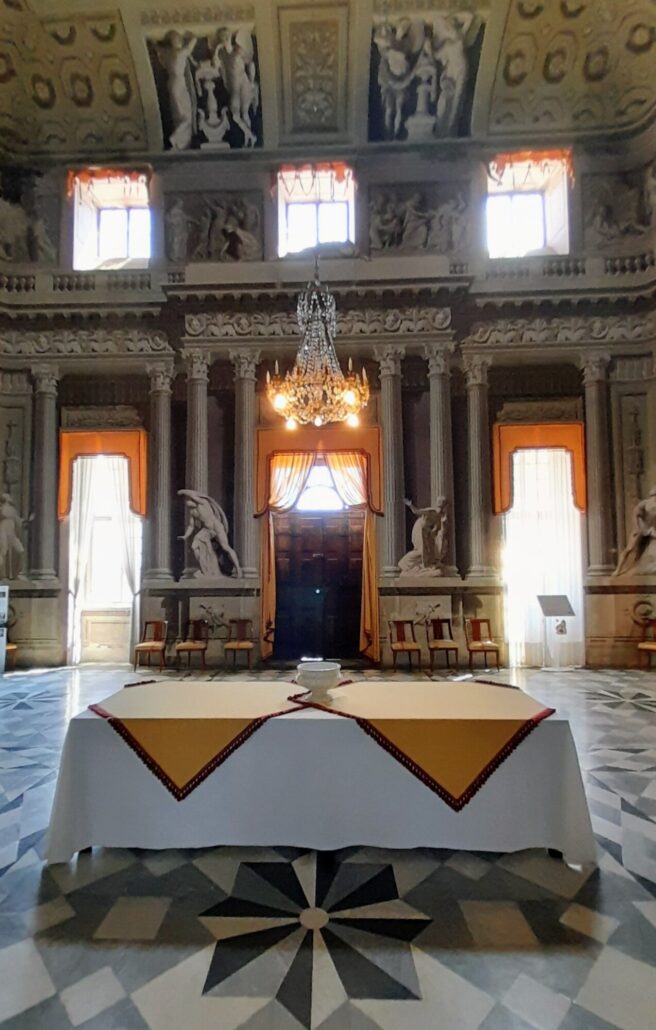
The piano nobile still preserves the atmosphere of the 19th-century court. The Queen’s and King’s apartments are decorated with magnificent frescoes inspired by classical mythology. Among them, the Hall of Honour stands out, where illusionistic painted architecture transforms the walls into a spectacular gallery of statues. At the centre of the ceiling is the myth of Niobe, inspired by the famous marble group preserved in the Uffizi Gallery and personally chosen by Carlo Felice during a stay in Florence. Among the castle’s most original rooms are the Chinese Rooms, decorated with extraordinary hand-painted wallpapers produced in China in the 18th century. The scenes depict porcelain production, tea cultivation, silk-making and numerous episodes of everyday life. They are a precious example of the fashion for chinoiserie, which captivated European courts during the 18th century and still makes these rooms unique among the historic residences of Piedmont.
The history of Govone Castle did not end with the fall of the monarchy. After the Savoy family sold the property, the municipality purchased the building and used it for elementary schools, a nursery school, municipal offices and the local magistrate’s court. Its inclusion in the UNESCO World Heritage List, together with the Royal Palace of Turin, ultimately contributed to the restoration of the piano nobile, which is now open to visitors.