The Royal Armoury of Turin
Armour, family treasures and extraordinary objects collected from across Europe are displayed in a museum that opened to the public in 1837 at the initiative of King Charles Albert: the Royal Armoury of Turin.
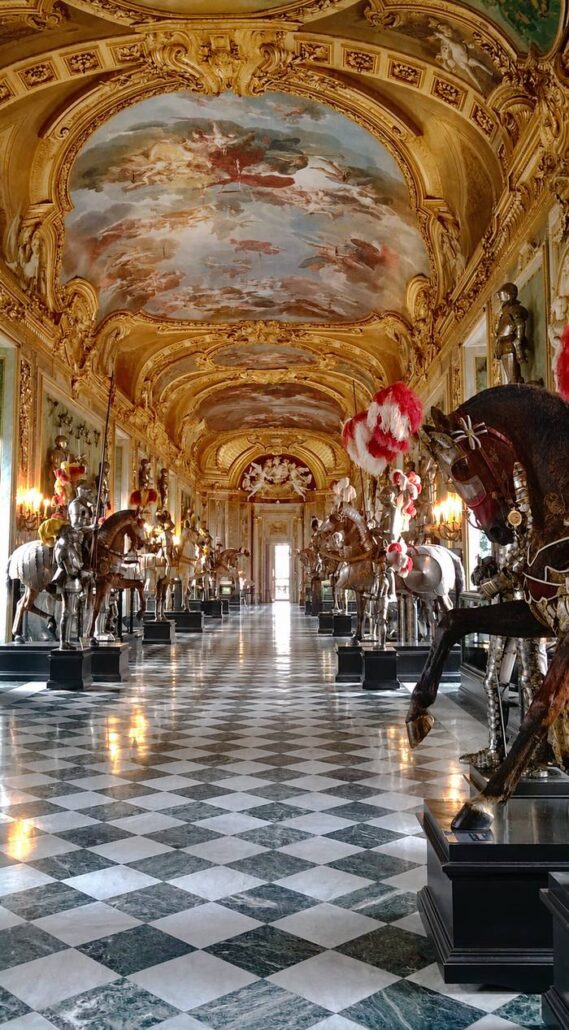
The visit begins in the small medal room, an intimate space that prepares visitors for the surprise of the gallery itself. As soon as you enter, you are struck by the perspective and the wealth of objects on display. The hall is an impressive 67 metres long, offering a spectacle that immediately captures the eye.
The nineteenth-century display is not simply a collection of weapons: it also evokes the world of theatre. The trophies arranged in the form of panoplies, decorative compositions of weapons, recall the stage sets of historical operas so popular in the nineteenth century. Together, these elements helped convey an idealised image of the sovereign: that of a just, valiant and courageous king, worthy of being celebrated as a knight.
However, the Gallery existed long before the Royal Armoury. It was built in 1732, during the reign of Charles Emmanuel III, as a reception hall. It was later decorated by the painter C. F. Beaumont with scenes from the story of Aeneas, while the architect B. Alfieri enhanced its appearance with polychrome marble and bas-reliefs celebrating the glories of Piedmont.
The true protagonists of the hall are the twelve mounted knights, arranged facing one another. The display begins with late medieval armour, accompanied by foot soldiers and mounted on tall wooden pedestals. This arrangement invites visitors to look upwards, almost as if they were contemplating statues or works of art.
And what about the horses? At first glance, they look like stuffed animals, but they are actually wooden sculptures covered with real horse hides. The sculptors skilfully reproduced a variety of poses: some horses rear up, like the one ridden by Prince Eugene at the far end of the gallery; others advance with a stately gait, like the horse of Duke Emmanuel Philibert. Together, these figures evoke scenes of battle, tournaments and military parades.
Among the most interesting suits of armour is the one first encountered on the right upon entering the hall, one of the most significant pieces acquired by Charles Albert. It belonged to a German knight from Nuremberg and probably dates from between 1520 and 1530. It is a composite suit of armour, fitted with interchangeable pieces that allowed it to be adapted both for warfare and for the joust, the mounted tournament. The embossed decorations depict centaurs with fish tails and a two-tailed mermaid, motifs associated with the owner’s coat of arms. The accessories also deserve attention. The wooden tournament lance dates from the nineteenth century, as do all the lances displayed in the gallery, but it is the horse’s armour that holds a particular surprise. Made from boiled and painted rhinoceros hide, it appears to have no connection with this suit of armour. The initials OHS, accompanied by a red heart, in fact refer to the marriage of another German prince: a small clue revealing how these objects can have complex and sometimes intertwined histories.
The Neo-Gothic display cases, designed by the architect Pelagio Palagi, take us even further back in time, to the Stone Age. Here we find flint axes, spearheads and daggers, evidence of a distant past.
We should not, however, be misled by the size of the display cases: the smallest ones, containing just a single object, may house truly exceptional pieces. One example is a sixteenth-century Venetian shield made from a sea turtle shell and covered with painted and gilded leather.
An unusual object that demonstrates how, in this gallery, weapons are not merely instruments of combat, but also works of art, symbols of prestige and small fragments of stories from across Europe.
Would you like to find out more? Book a guided tour of the Royal Palace of Turin.