Turin and more
  • About me
  • Turin guided tours
  • Tailor Made Tours
    • Andalusia
    • Sicily
    • Normandy and Brittany
  • Conditions
  • Blog
  • Contact
  • English
    • Italian
  • Menu Menu
  • Link to Facebook
  • Link to Instagram

Tag Archive for: #patrimoniounesco

The Royal Armoury of Turin

in Must-see

Armour, family treasures and extraordinary objects collected from across Europe are displayed in a museum that opened to the public in 1837 at the initiative of King Charles Albert: the Royal Armoury of Turin.
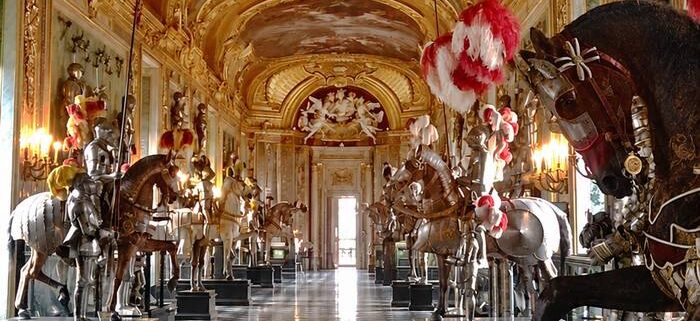
The visit begins in the small medal room, an intimate space that prepares visitors for the surprise of the gallery itself. As soon as you enter, you are struck by the perspective and the wealth of objects on display. The hall is an impressive 67 metres long, offering a spectacle that immediately captures the eye.
The nineteenth-century display is not simply a collection of weapons: it also evokes the world of theatre. The trophies arranged in the form of panoplies, decorative compositions of weapons, recall the stage sets of historical operas so popular in the nineteenth century. Together, these elements helped convey an idealised image of the sovereign: that of a just, valiant and courageous king, worthy of being celebrated as a knight.
However, the Gallery existed long before the Royal Armoury. It was built in 1732, during the reign of Charles Emmanuel III, as a reception hall. It was later decorated by the painter C. F. Beaumont with scenes from the story of Aeneas, while the architect B. Alfieri enhanced its appearance with polychrome marble and bas-reliefs celebrating the glories of Piedmont.
The true protagonists of the hall are the twelve mounted knights, arranged facing one another. The display begins with late medieval armour, accompanied by foot soldiers and mounted on tall wooden pedestals. This arrangement invites visitors to look upwards, almost as if they were contemplating statues or works of art.
And what about the horses? At first glance, they look like stuffed animals, but they are actually wooden sculptures covered with real horse hides. The sculptors skilfully reproduced a variety of poses: some horses rear up, like the one ridden by Prince Eugene at the far end of the gallery; others advance with a stately gait, like the horse of Duke Emmanuel Philibert. Together, these figures evoke scenes of battle, tournaments and military parades.
Among the most interesting suits of armour is the one first encountered on the right upon entering the hall, one of the most significant pieces acquired by Charles Albert. It belonged to a German knight from Nuremberg and probably dates from between 1520 and 1530. It is a composite suit of armour, fitted with interchangeable pieces that allowed it to be adapted both for warfare and for the joust, the mounted tournament. The embossed decorations depict centaurs with fish tails and a two-tailed mermaid, motifs associated with the owner’s coat of arms. The accessories also deserve attention. The wooden tournament lance dates from the nineteenth century, as do all the lances displayed in the gallery, but it is the horse’s armour that holds a particular surprise. Made from boiled and painted rhinoceros hide, it appears to have no connection with this suit of armour. The initials OHS, accompanied by a red heart, in fact refer to the marriage of another German prince: a small clue revealing how these objects can have complex and sometimes intertwined histories.
The Neo-Gothic display cases, designed by the architect Pelagio Palagi, take us even further back in time, to the Stone Age. Here we find flint axes, spearheads and daggers, evidence of a distant past.
We should not, however, be misled by the size of the display cases: the smallest ones, containing just a single object, may house truly exceptional pieces. One example is a sixteenth-century Venetian shield made from a sea turtle shell and covered with painted and gilded leather.
An unusual object that demonstrates how, in this gallery, weapons are not merely instruments of combat, but also works of art, symbols of prestige and small fragments of stories from across Europe.

Would you like to find out more? Book a guided tour of the Royal Palace of Turin.

https://www.turinandmore.com/wp-content/uploads/2026/10/Galleria_barocca_200kb.jpg 1268 700 Andrea https://www.turinandmore.com/wp-content/uploads/2019/07/logodef-1-300x208.png Andrea2026-10-23 19:59:292026-10-23 20:29:11The Royal Armoury of Turin

Turin Royals Gardens

in Trip Inspiration

Behind the Royal Palace of Turin, at the heart of the prestigious UNESCO-listed Savoy Residences, lie the Royal Gardens. Originally designed in the Italian garden style and later transformed according to the principles of the French formal garden, they remain one of the city’s most important historic green spaces. Today, the Royal Gardens are divided into three main areas: the Ducal Garden, distinguished by its striking green bastion; the Boschetto, where historical heritage meets contemporary art; and the Arts Garden.

The Ducal Garden

The Ducal Garden features numerous ornamental vases that recreate the appearance of the garden as it looked in 1875. Only four of these are original; the others have been carefully reconstructed, faithfully reproducing their original shapes and decorations, while deliberately simplifying certain details so they can be distinguished from the authentic historic pieces. Arranged along the parterre and the main pathways, these decorative elements reflect the theatrical taste of the Savoy court. Originally, the vases rested on marble bases; today, they stand on granite pedestals incorporating a lighting system that enhances the garden paths after sunset. This ornamental model proved especially successful and was later reproduced in bronze to decorate the gardens of the Royal Villa of Monza during the nineteenth century.

Along the façades of the Royal Palace and the Sabauda Gallery stand the historic citrus planters, large containers once used to house orange and lemon trees, symbols of prestige and refinement in the gardens of European courts. During winter, these plants were traditionally sheltered indoors to protect them from the cold; according to Turin tradition, they were even stored inside the State Archives, designed by Filippo Juvarra.

Today, for practical and conservation reasons, the planters remain outdoors throughout the year. Consequently, they are no longer made of wood but of stainless steel, a material far more resistant to weathering. Instead of citrus trees, they now contain Japanese privets, evergreen plants with thick, glossy leaves that resemble orange trees. The containers nevertheless reproduce the historic design: their grey exterior recalls the appearance of cast iron, while the green interior evokes the timber used in the original structures.

The Boschetto

This area was returned to the city thanks to the initiative of the Consulta di Torino, which celebrated the thirtieth anniversary of the association bringing together 32 of the region’s leading companies. Landscape architect Paolo Pejrone oversaw the redesign of the Boschetto, while artist Giulio Paolini created the site-specific installation Precious Stones (2017). Designed specifically for this location, the installation is inseparable from its setting. Fragments and remains recovered from the collapse of the vault of the Chapel of the Holy Shroud are transformed from simple debris into the central elements of the composition, becoming powerful symbols of memory and of an event deeply rooted in the history of Turin.

At the centre of the installation sits a young man, a symbolic figure who does not represent any particular individual but rather humanity contemplating and reflecting. He almost becomes the visitor’s alter ego: according to Paolini, the viewer’s gaze completes the artwork itself. Art thus becomes a mental space where image, place and historical memory come together through the observer’s own perception.

The Boschetto is home to species typically found in cool, shaded environments, including acanthus and ferns. Young walnut trees may also occasionally appear among the vegetation. They are the result of squirrels burying walnuts in the ground as food reserves. Some are forgotten and eventually sprout naturally, although they are later removed together with invasive plants to preserve the botanical design of the woodland understory, where shrubs and herbaceous plants create an attractive interplay of light and shade.

The Arts Garden

The Arts Garden, also known as the Eastern Garden, is home to a replica of Spring by Simone Martinez. The original sculpture is displayed in the Alfieri Rondò of the Royal Palace of Venaria, one of the most remarkable Savoy Residences. The replica was carved from Carrara marble using a three-dimensional survey of the original sculpture, followed by meticulous hand finishing that faithfully reproduces both the exquisite details and the expressive quality of the eighteenth-century masterpiece.

The eastern section of the gardens is dominated by the large parterre with its reflecting pool, one of the most spectacular features of the entire complex. Its design was conceived by the celebrated French landscape architect André Le Nôtre, the creator of the gardens of Versailles. During the eighteenth century, this area underwent major improvements in keeping with the refined taste of the Savoy court. At its centre stands the Fountain of the Tritons, whose large basin, based on Le Nôtre’s original design, was restored in 1739. In 1757, the white Valdieri marble sculptural group created by Simone Martinez was installed. The composition depicts a lively marine world inhabited by tritons, a Nereid, fish, turtles and small tritons portrayed as playful putti interacting with one of the two pelicans that complete the scene.

The Cavallerizza Gardens, on the other hand, were separated from the oldest section of the Royal Gardens in 1923 following the construction of the road linking Piazza Castello with Corso Regina Margherita. Their geometric layout, with avenues radiating from a central point, reproduces the characteristic goose-foot pattern, a distinctive feature of the French formal garden perfected by Le Nôtre.

Would you like to discover more? Book a guided tour of the Royal Palace of Turin.

https://www.turinandmore.com/wp-content/uploads/2026/08/20260726_093140.jpg 717 1547 Andrea https://www.turinandmore.com/wp-content/uploads/2019/07/logodef-1-300x208.png Andrea2026-08-06 07:24:202026-08-06 07:25:47Turin Royals Gardens

Categories

  • contemporary art
  • gastronomy
  • Must-see
  • Trip Inspiration

Archives

  • November 2026
  • October 2026
  • September 2026
  • August 2026
  • July 2026
  • April 2026
  • March 2026
  • February 2026
  • January 2026
  • December 2025
  • November 2025
  • October 2025
  • September 2025
  • August 2025
  • July 2025
  • June 2025
  • May 2025
  • April 2025
  • March 2025
  • February 2025
  • January 2025
  • December 2024
  • November 2024
  • October 2024

Menu

  • Home
  • About me
  • Contact

Turin and Piedmont guided tours

by Andrea Clementino

Events and Tailor Made Tours

Privacy


  • Turin and Piedmont Guided tours
  • Tailor Made Tours
P.IVA 11200290010 © Copyright - Turin&More | WD: Officina Informatica
  • Link to Facebook
  • Link to Instagram
Scroll to top Scroll to top Scroll to top

WhatsApp